
Key Takeaways
- Perforated sheets are metal sheets with precisely punched holes that provide excellent strength, ventilation, filtration, and an attractive appearance for industrial and architectural applications.
- They are manufactured using CNC punching and precision tooling, ensuring accurate hole patterns, consistent quality, and customized designs for different industries.
- Perforated sheets are widely used in construction, filtration, sugar mills, food processing, mining, pharmaceuticals, HVAC systems, agriculture, and machine safety applications.
- They offer key benefits such as better airflow, efficient filtration, lightweight construction, corrosion resistance, noise reduction, and long service life.
- Perforated sheets help reduce heat buildup by improving natural airflow, while the perforated sheet price depends on factors like material, thickness, hole pattern, and sheet size. Choosing a trusted perforated sheet manufacturer such as Fine Perforators ensures quality products and reliable service.
Perforated sheets are widely used across industries because they offer the perfect balance of strength, ventilation, filtration, and durability. From industrial filtration systems to modern architectural projects, these sheets serve multiple purposes while maintaining excellent structural performance. Whether you are looking for a reliable perforated sheet manufacturer, comparing perforated sheet price, or searching for a trusted perforated sheet supplier in India, understanding the product helps you make the right decision.
What Is a Perforated Sheet?
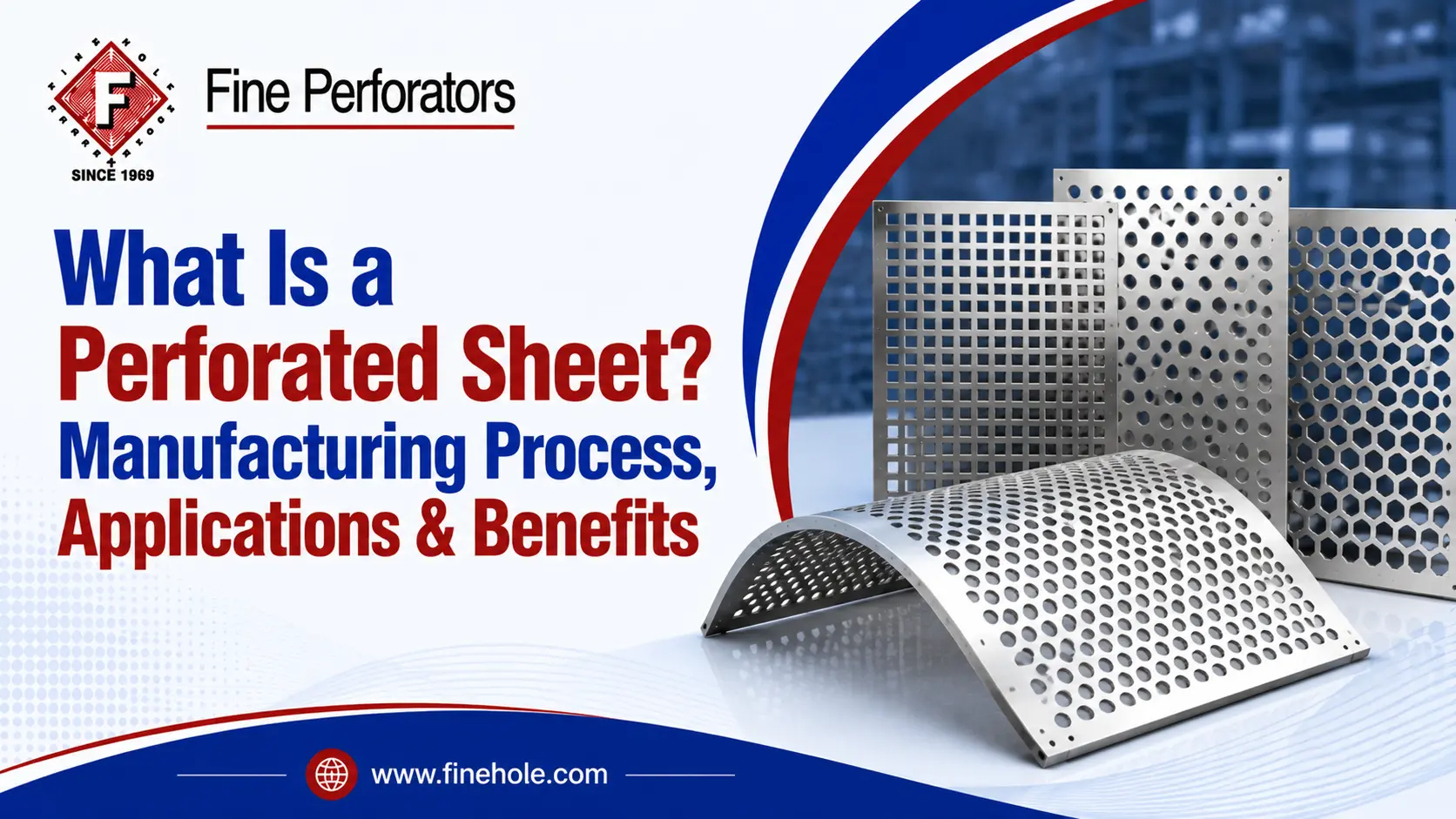
A perforated sheet is a metal sheet with a series of uniformly punched holes arranged in different patterns. These holes can be round, square, slotted, hexagonal, or customized according to the application. The design allows air, light, liquid, or sound to pass through while maintaining the sheet's strength.
Manufacturers produce perforated sheets in stainless steel, mild steel, galvanized iron, aluminium, brass, and copper. Depending on the industry, customers can choose different hole sizes, sheet thicknesses, and open area percentages.
How Are Perforated Sheets Made?
If you are wondering how are perforated sheets made, the process starts with selecting the right metal based on the application. Manufacturers then prepare the sheet and use CNC punching or precision tooling to create accurate hole patterns. Advanced machinery ensures every hole is uniform and meets customer specifications.
After perforation, the sheets go through deburring, leveling, cleaning, and quality inspection before dispatch.
Different Types of Perforated Sheets
Perforated sheets are available in different materials to suit various industrial requirements. Stainless steel sheets are ideal for corrosion-resistant applications, while mild steel offers strength at an economical cost. Galvanized iron sheets perform well in outdoor environments, and aluminium sheets provide lightweight yet durable solutions.
Apart from standard materials, decorative perforated sheets are also available for architectural and interior projects.
Common Hole Patterns
The hole pattern of a perforated sheet directly affects its strength, airflow, filtration efficiency, drainage, and overall performance. Different industries require different perforation designs depending on their application. From industrial screening to architectural facades, selecting the right hole pattern ensures better functionality and long-term performance.
- Round Holes: The most widely used pattern for ventilation, filtration, drainage, and general industrial applications.
- Square Holes: Suitable for screening, sorting, and material separation where higher open area is required.
- Slotted Holes: Ideal for liquid drainage, grain processing, dewatering, and applications requiring directional flow.
- Hexagonal Holes: Provide a high open area, making them suitable for airflow, filtration, and lightweight structural applications.
- Decorative Patterns: Used in architectural facades, ceilings, partitions, railings, and interior design projects to combine functionality with aesthetics.
- Custom Perforation Patterns: Manufactured according to customer drawings, hole sizes, spacing, and technical specifications for specialized industrial requirements.
Perforated Sheet Specifications
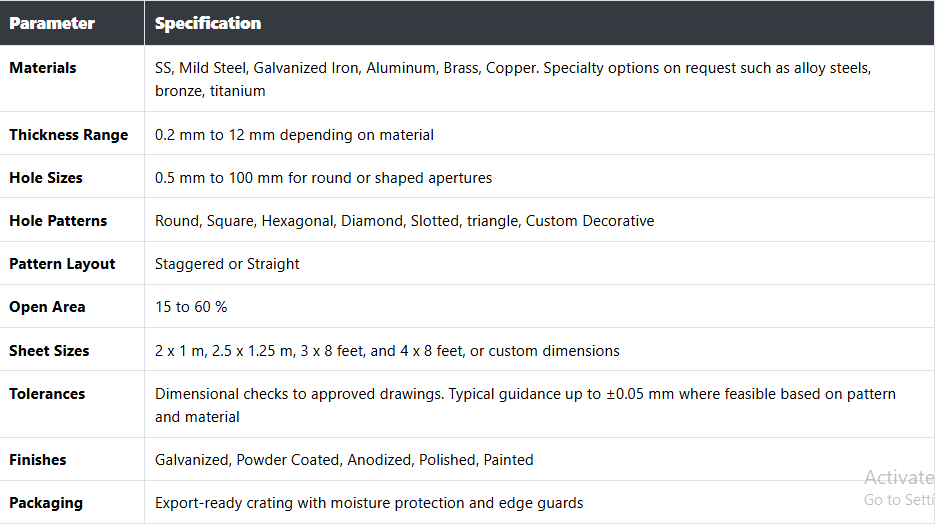
Perforated sheets are available in a wide range of materials, thicknesses, hole sizes, and finishes to meet different industrial and commercial requirements. The specifications below provide a general overview of the customization options available for various applications.
Where We Use Perforated Sheet
One of the most common questions buyers ask is where we use perforated sheet. Due to their versatility, perforated sheets are used across numerous industries for filtration, screening, ventilation, protection, and decorative purposes. Their durability and customizable designs make them suitable for both industrial and commercial applications.
| Industry/Application | Use of Perforated Sheets |
| Architecture & Building Facades | Used in facades, sunshades, railings, and decorative panels. |
| Industrial Filtration | Supports filter media for liquid and gas filtration. |
| Sugar Industry | Used in centrifugal machines for sugar processing. |
| Food Processing | Applied in sorting, drying, washing, and conveyor systems. |
| Mining Industry | Used for screening and material separation. |
| Pharmaceutical Industry | Used in sieving, filtration, and processing equipment. |
| Chemical Plants | Installed in filtration and ventilation systems. |
| Agricultural Equipment | Used for grain cleaning, drying, and seed processing. |
| HVAC Systems | Improves airflow in ducts and ventilation panels. |
| Noise Control Panels | Helps reduce noise when combined with insulation. |
| Machine Guards | Protects equipment while allowing visibility and airflow. |
| Interior Decoration | Used in partitions, ceilings, furniture, and wall panels. |
Benefits of Using Perforated Sheets
Perforated sheets are widely preferred because they combine durability, functionality, and cost-effectiveness in a single product. Their unique design improves airflow, filtration, and strength while reducing the overall weight of the sheet. Whether used in industrial equipment or architectural projects, they deliver reliable long-term performance.
Key Benefits:
- Better ventilation and airflow
- Lightweight without compromising strength
- Efficient filtration and screening
- Attractive and modern appearance
- Improved acoustic performance
- Corrosion-resistant material options
- Long service life with low maintenance
- Easy to cut, bend, weld, and fabricate
Does Perforated Sheet Save From Heat?
A common question buyers ask is does perforated sheet save from heat. While perforated sheets do not completely block heat, they help reduce heat buildup by improving airflow and ventilation. This makes them useful in buildings, machine enclosures, and industrial ventilation systems.
Architects often use perforated metal panels in facades and sunshades to minimize direct sunlight while allowing fresh air to circulate. This improves indoor comfort and contributes to better thermal performance when used with proper insulation.
What Is the Rate of Perforated Sheet?
Another frequently searched question is what is the rate of perforated sheet. There is no fixed perforated sheet price because the cost depends on several factors, including the material, sheet thickness, hole size, hole pattern, dimensions, and order quantity.
Custom perforated sheets generally cost more than standard designs due to additional tooling and manufacturing requirements. For the best perforated sheet price, it is always recommended to share your exact specifications with the manufacturer and request a customized quotation.
How to Choose the Right Perforated Sheet Manufacturer
Selecting the right perforated sheet manufacturer is essential for getting a product that meets your quality and performance requirements. Look for a company that offers multiple material options, customization capabilities, advanced manufacturing facilities, and strict quality control.
You should also check whether the manufacturer provides technical support, timely delivery, and experience in serving different industries. Working with an established supplier ensures better product quality and long-term reliability.
Fine Perforators is a trusted perforated sheet supplier in India and an experienced perforated sheet exporter in India, serving customers across various industries. The company manufactures precision-engineered perforated sheets using advanced machinery and high-quality raw materials.
With years of manufacturing expertise, customized production capabilities, and a commitment to quality, We deliver perforated sheets that meet both Indian and international standards. Today, we supply high-quality perforated products to customers in Brazil, Mexico, Dubai, the Philippines, Thailand, Vietnam, Pakistan, Bangladesh, Iran, Jordan, Malaysia, Sri Lanka, and Indonesia. Our commitment to quality, customer satisfaction, and timely delivery continues to drive our growth in international markets.
Conclusion
Now that you know what is perforated sheet, how are perforated sheets made, where we use perforated sheets, does perforated sheet save from heat, and what is the rate of perforated sheet, choosing the right product becomes much easier. The right material, hole pattern, and manufacturing quality can significantly improve the performance and lifespan of your application.
If you are looking for a reliable perforated sheet manufacturer, perforated sheet supplier in India, or perforated sheet exporter in India, Fine Perforators offers high-quality perforated sheets in a wide range of materials, hole patterns, and custom specifications to meet your industrial and commercial requirements.
Frequently Asked Questions
What is perforated sheet?
A perforated sheet is a metal sheet with uniformly punched holes that improve ventilation, filtration, drainage, and appearance while maintaining structural strength.
How are perforated sheets made?
Manufacturers produce perforated sheets using CNC punching or precision punching machines, followed by deburring, finishing, and quality inspection.
Where we use perforated sheet?
Perforated sheets are used in architecture, industrial filtration, food processing, sugar mills, mining, pharmaceuticals, HVAC systems, agriculture, and machine guards.
Does perforated sheet save from heat?
Yes, perforated sheets improve airflow and reduce heat buildup, making them suitable for ventilation systems, building facades, and industrial enclosures.
What is the rate of perforated sheet?
The perforated sheet price depends on factors such as material, thickness, hole pattern, dimensions, and quantity. Contact Fine Perforators for a customized quotation.